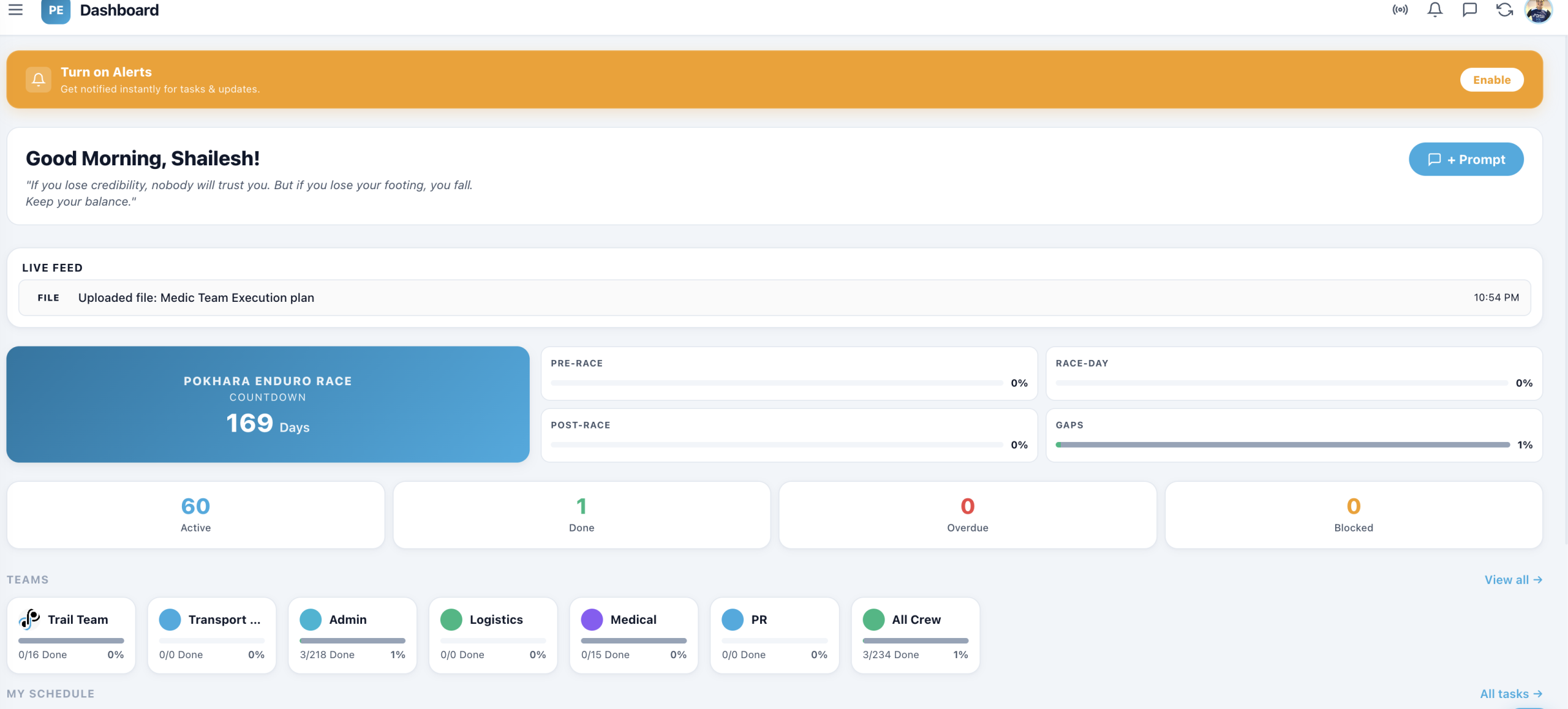
Managing a large-scale outdoor sports event like an Enduro mountain bike race is never just about spreadsheets. It involves real-time coordination, unreliable connectivity in the field, fast decision-making, and constant communication between teams spread across different locations.
To handle this, I built a fully custom event management platform consisting of a Progressive Web App (PWA) and a REST API. It is designed to act as the central system for race operations, covering task management, incident reporting, inventory tracking, and field-level financial logging. The goal was simple: reduce friction for crews working in unpredictable outdoor environment.
Key Features
AI-powered document processing Event teams deal with long PDFs, spreadsheets, and mixed-format files that are painful to read on a phone in the field. I built a background processing pipeline that ingests uploaded documents and turns them into clean, markdown-formatted summaries — so crews get the key points instead of scrolling through pages. A multi-provider AI routing layer keeps this reliable, and everything runs asynchronously through queues so uploads never block the app.
Natural language event management Rather than routing every action through a form, I built a conversational input layer for day-to-day event operations. A crew member can just type:
- “Remind Sunil to check sector 3 tomorrow”
- “Spent 500 on fuel by Rakesh”
- “Incident: rider fell at the big jump”
The system parses intent and entities from plain text and converts it straight into structured records — tasks, expense entries, incident reports — no menus required. I extended this further with OCR, so a photo of a receipt can be logged the same way.
Task system with hierarchy and dependencies: Real event logistics aren’t flat to-do lists, so the task system supports nested subtasks, group assignment, and dependency chains, with built-in checks to prevent circular dependencies. Teams can see exactly what has to happen first and how each piece of the event connects to the next.
Offline-first field apps: Two installable progressive web apps — one for crew, one for participants — built to keep working when a venue’s signal doesn’t. Actions taken offline (task updates, chat messages, form submissions) queue locally and sync automatically the moment connectivity returns. Both apps now share the same service worker caching strategy end to end: the app shell precaches for an instant first load, and API responses are cached with edition-aware, per-tenant isolation so repeat visits render instantly from cache while refreshing in the background — rather than one app having the offline resilience and the other just the shell.
Live updates and WebPush notifications: Field teams shouldn’t need to manually refresh to stay current. A real-time layer over WebSockets delivers instant updates on task changes, incidents, and messages, with automatic fallback to polling if a socket connection isn’t available — paired with WebPush notifications straight to the browser, no app install required, which matters in low-connectivity, low-resource event environments.
Route planning and crew logistics: For events that need to position crew across a course or venue, I built a route planner that detects pickup corridors and estimates detour cost for crew logistics, using Google Maps for routing and geocoding with an automatic fallback to a free open-source routing service when no API key is configured — so the feature degrades gracefully instead of breaking.
Participant registration, payments, and self-service: On the participant side, the platform handles end-to-end registration with integrated payments — Stripe and PayPal for real checkout, plus a manual QR-payment workflow with admin approval for cash-first markets. Post-registration, participants get self-service tools like QR-triggered, pre-filled, signable checklist forms, replacing paperwork at the event site.
SaaS-ready licensing and quotas: The platform is built with multi-tenant SaaS support in mind. I implemented a licensing and quota system enforced at the API level — RSA-signed license verification, tier-based limits, usage tracking, and automated email alerts before a plan expires — making it ready to run as a real commercial product across multiple customer deployments, not just a single install.
Per-tenant access control: For teams running multiple events on one deployment, I built a full access-control audit across the admin panel: an account restricted to specific events can no longer see or modify data outside those events, enforced consistently across crew, participants, registration forms, checklists, FAQs, event locations, messaging, and notifications. Super-admin accounts are unaffected — this only tightens what a restricted account can reach, closing gaps a single-tenant design doesn’t have to think about.
Security and reliability: Since this runs live event operations, stability isn’t optional. The API is built with strict authentication, CAPTCHA-backed abuse prevention, and automated test coverage across core workflows, so it holds up under real-world load.
Outcome
The result is a flexible, AI-assisted event operations platform that cuts down manual coordination and speeds up response time in the field which is built to work even when connectivity and time are both scarce. Teams spend less time managing tools, and more time running the event.